Francis William Schryer
b. 23 July 1917
d. 18 June 1961
Married 18 Jan 1941
Elaine widowed 19 Nov 1961
Elaine Shirley Jackson
b. 3 May 1921
d. 4 Jan 2009
Elaine and Fran met at the home of mutual friends. The teen girls were making fudge. The young men went out for the evening and then Fran suggested that they go back to the house for candy. The couple was introduced. And they fell in love with a passion that lasted for the rest of their lives.
They courted for several years, going to Frankenmuth for chicken dinners, to the countryside for picnics, and taking Elaine’s youngest brother, Duane, to see the magnificent Christmas displays in the Hudson’s department store windows.
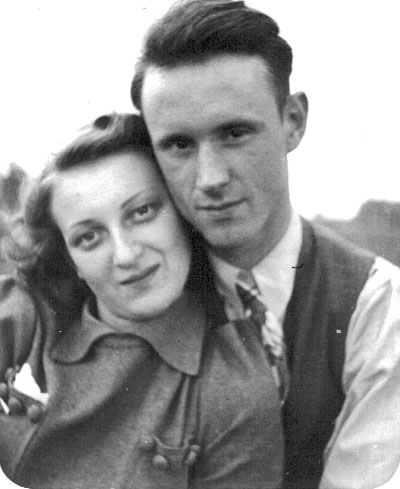
While they were courting, Grandma was still in high school; Fran had graduated from high school two years early, at the age of 16, and was apprenticed as a tool and die maker. Interestingly, this mechanical trait manifested itself in his son Tom’s life some 60 years later. Tom got a patent on a new kind of guitar called ChordBender and designed and arranged for the casting and machining of the special parts.
Fran was four years Elaine’s senior and he had been living in his parent’s home, paying for room and board, but also saving his wages. He pressed her to get engaged while she was still in high school. “Don’t ask, Fran,” she said. She knew she would marry him, but she didn’t want to commit herself before graduation.
The couple were engaged the summer after she graduated and they married the following January, in a snow storm. Her mother Lucy planned the wedding. Elaine said her mother was better at such things than she was at 19 and the ceremony was beautiful. Elaine and Fran had three children and she lived to see a healthy host of grandchildren and great grandchildren.
Between them, they had enough savings to buy a small house, where they spent their wedding night. They honeymooned in the Smokey Mountains.
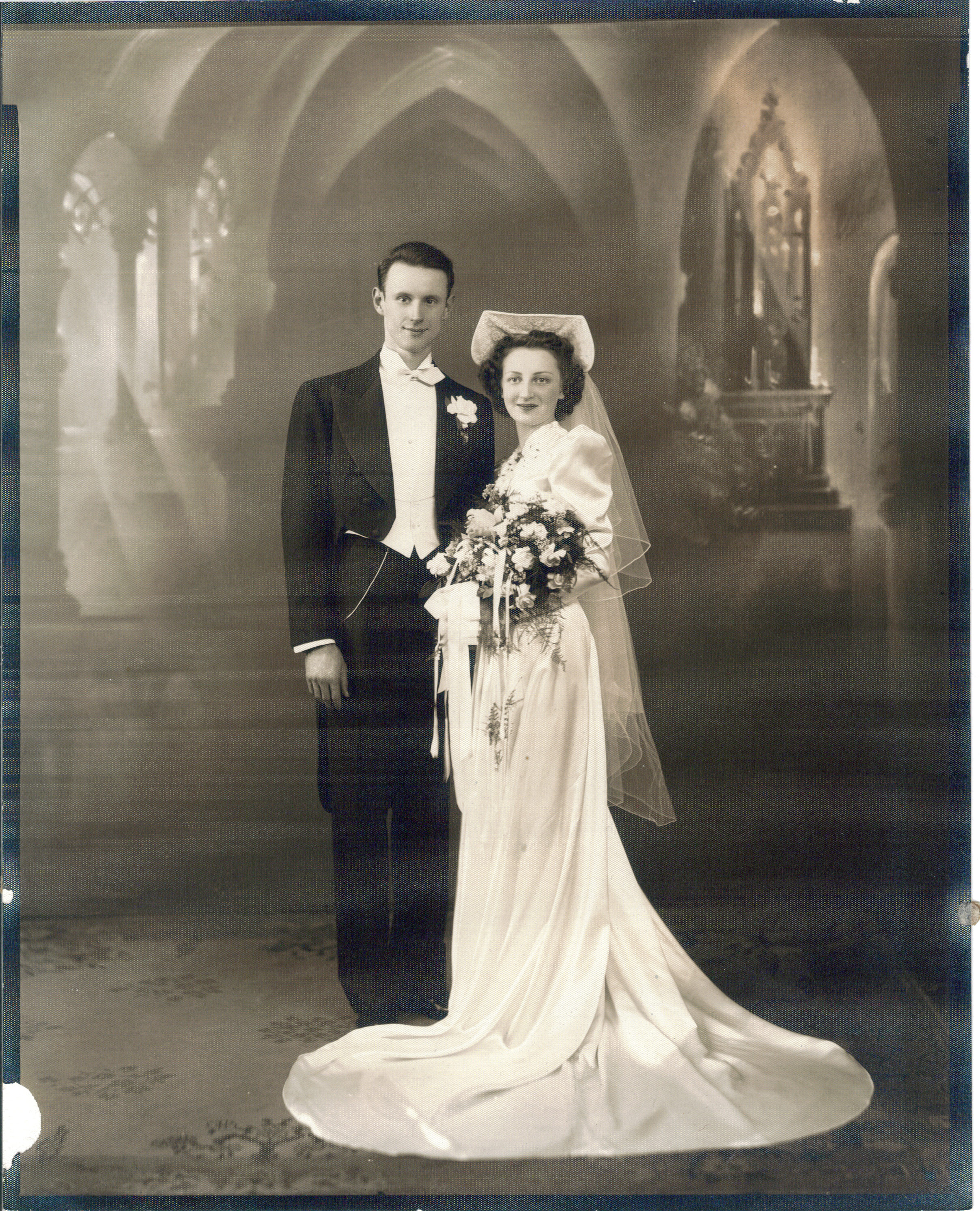
Elaine and Fran’s wedding photo looks like a page out of a Hudson’s modeling book. She bought the most expensive wedding dress she could find, a rare extravagance.
Elaine became pregnant shortly after their first year of marriage and miscarried in the first trimester. She went on to have three successful births: Norman Loren, Diane Elaine, and Thomas Gordon.
She had a difficult time with pregnancy due to scoliosis and after Diane was born her doctor advised the couple not to have any more children. But they wanted more children. Elaine had significant difficulty with her third pregnancy but Tom was born by Caesarean. Afterwards, the doctor took Fran into a room and told him that if she got pregnant again he might have a baby but he wouldn’t have a wife. That was the end of child bearing.
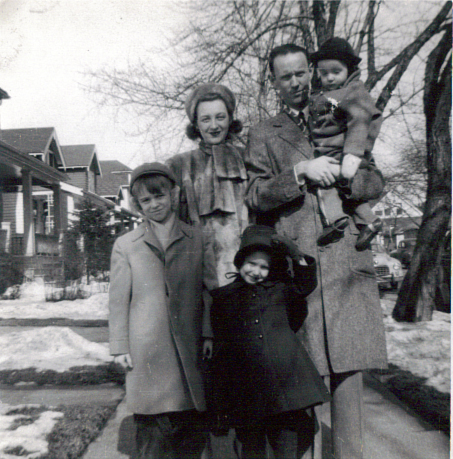
Tom told me his father was a classic dad: distant but not unloving. He remembers a particularly happy afternoon when he was about four and his father put him in a wheelbarrow and rode him around the yard.
Family Life in the 1950’s
Mintz, Steven, and Susan Kellogg. Domestic revolutions: A social history of American family life. New York: Collier Macmillan, 1988.
and
Young, W. H., & Young, N. K. (2004). American popular culture through history: The 1950s. Westport, CT: Greenwood Press.
Family life in the 1950s was a unique period in American history. Divorce rates were at an exceptional (and historically unsustainable) low. Since 1910, the birthrates for white, American-born women had been on the decline. The 1950s changed that. The U.S. birthrate rivaled that of India. Three to four children were considered an ideal by many American couples. Women and men were marrying younger, having more children, and spacing them closer together. Fewer than one in ten Americans believed an unmarried person could be happy.
The sense of a U.S. family with the husband and father as breadwinner and the wife and mother as a homemaker was the public ideal. A phrase was coined to term the workings of this new nuclear unit: togetherness.
Despite periods of recession and periodic high unemployment, the standard of living rose dramatically. Between 1950 and 1960 the Gross National Product (GNP) grew from $285 billion to $500 billion. Families that had been held back during the Depression and World War II suddenly had the financial resources to have more children and a home of their own. Nuclear family home ownership rates skyrocketed with a housing boom; the suburbs were born.
Cost of common objects from the 1950s (Young and Young, p. 285-6):
Eggs: $.72/dozen
Coffee: $.55/pound
Median price for a single family home (1950): $10,050
Refrigerator: $200
Electric stove: $100
Round-trip air, New York to California: $88
Mid-grade American sedan (1959): $2,800
Imported compact cars (1959): $1,500
Ground-breaking works such as The Feminine Mystique by Betty Friedan explored the isolation and lack of intellectual fulfillment many women were feeling. By the end of the 50s and beginning of the 60s, more and more women were re-entering the workforce, generally as clerks and secretaries. The choice to marry young and space children closer together after World War II meant that many women had more time in their 30s and 40s to explore personal interests.
The sexual revolution and social upheaval of the 1960s brought divorce rates back to historical averages. In the end, one quarter to one third of marriages made in the 1950s ended in divorce.
Fran and Elaine had a strong and sustaining romance. After I read The Feminine Mystique I asked Grandma if she had felt stifled in the 1950s. She said no, not at all. She was happily married and the children were wonderful. Grandma lived the life she wanted.
My Grandfather. And the Mafioso.
Burnstein, S. M. (2006). Images of America. Motor city mafia: A century of organized crime in Detroit. Charleston, SC: Arcadia Publishing.
Norm has long recounted a legend about living in Detroit as a kid. He was the only one among the siblings old enough to remember this particular incident; he was 11 when it happened. In my family history research I naturally went to find out more about it and the facts are even better than the part of the history we knew.
Let’s start out with the family story. Norm remembers a night in 1954 when Mr. L., an American neighbor of Italian descent, went up and down the street apologizing for the disturbance that the bomb someone tried to throw into his house had caused. The sloppy hit men destroyed a neighbor’s porch instead. Mr. L. paid for the damage and assured the porch-less neighbor that such a thing would never happen again. The family story goes on to mention a story in the paper a few days later about bodies found in the Detroit River…
I located the book Motor city mafia: A Century of organized crime in Detroit by Scott M. Burnstein and also looked up Mr. L.’s family in Polk’s Detroit City Directory for 1954. I didn’t necessarily expect to find a rich history about the L. family. Genealogy is often a lot of reading for little information. But not in this case.
The Detroit City Directory confirmed that an L. family did indeed live just down the street from my grandparents; he was a union representative for the Congress of Industrial Organizations. It was commonly known in the neighborhood that this particular Mr. L. was in the mob but I could not verify that independently. The larger L. family itself, however, has a rich mob history. Beginning with Prohibition, they worked large-scale liquor smuggling from Ontario as members of the River Gang. The book referred to the L.’s as “bootlegging czars.”
Norm remembers playing with children from both the L. family and an additional family, the T. family. Norm and my mom both remember Mrs. T.’s kitchen, which had taken over the basement to give her enough space to work. She made fresh bread daily and all of her own pasta. You couldn’t get out of the house without a bit of something to eat. Mom reports there was always a little bowl to return to Mrs. T. when you went back to visit. Mom’s favorite ethnic food to this day is Italian.
After Prohibition ended, according to Motor City Mafia, one member of the T. family successfully headed the Detroit mafia for 5 years. When he went to prison for tax evasion, he passed the mantle to Z., who ruled the Detroit underworld for 40 years “building the crime family into a juggernaut of vice and corruption and a model of underworld stability and efficiency.” Z. put one of the L. brothers in charge of the new and larger crime family’s financial affairs as well as two of the syndicate’s out-of-state underworld interests. One member of the T. family was made consiglieri.
Norm remembers both men as friendly: good neighbors and good fathers who encouraged games among the kids like stickball. They threw barbeques in the back yard. Just normal families. We don’t know where these two men fell in the crime family’s hierarchy, if, in fact, they did at all. Well, high enough to warrant a murder attempt in any case. No T. family was listed in the Detroit directory for 1954, although they did live there, and Uncle N. remembers them. Mr. T. ran a landscape company. In fact, he took care of Mr. L’s yard.
Bootlegging czars, bombs, unions, and consiglieris. The truth was even better than the family legend. Now how often does that happen?
Detroit
No story about our family would be complete without a few crucial mentions of the city of Detroit. William Arthur first moved to the city during Detroit’s heyday of the early 20th century. His children and grandchildren grew up in and around the city and some still live in the suburbs. The city has rich, full and wonderful memories for the family.
Hudson’s and Sanders
Hauser, M., & Weldon, M. (2004). Images of America. Hudson’s: Detroit’s legendary department store. Charleston, SC: Arcadia Publishing.
|
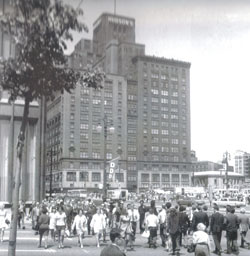
Hudson’s Building, 1970s |
Hudson’s was founded in 1881 by J.L. Hudson. The downtown Detroit department store on Woodward Avenue grew to house 2.2 million square feet and 49 acres of floor space.
Our family shopped there for generations. Hudson’s was famous for its outstanding quality products, superior services and incredible range of offerings. They had 200 departments and 16,000 vendors. Elaine was registered at Hudson’s for her wedding, as was her daughter Diane, as was I, although by the time I came of age the downtown Hudson’s building was long gone, of course.
My mom Diane remembers her grandmother, Lucy, taking her to see Hudson’s Santa (the “real” Santa). Little did she know that Santa spoke five languages so he could properly interact with children of immigrant families.
Even after moving to Hillsdale, the family continued to shop at Hudson’s. Except for a few living room pieces purchased when they got married, the family bought their furniture at Hudson’s and had it delivered the 100 miles to Hillsdale. Hudson’s 9th floor furniture galleries featured 40 model rooms that changed seasonally. The store delivered 900,000 pieces of furniture before it closed.
J.L. Hudson was also a philanthropist, improving the city of Detroit in many ways including laying the groundwork for the founding of the United Way. He supported the state fair, the Detroit Institute of Arts, the Detroit Board of Commerce and many other initiatives.
One proud family moment at Hudson’s came when Lucy was shopping with Elaine, a small child at the time, in the children’s clothing department. As they prepared to leave, the head of children’s purchasing came running to catch up with them. “Where did you buy your daughter’s clothes?” she wanted to know. Lucy responded that she had made them. “Of course,” the buyer replied with a somewhat sad smile. There are degrees of craftsmanship that not even Hudson’s could meet all of the time.
Although J.L. Hudson died in 1912, the store remained a family-run business through its 1969 merger with Dayton to become Dayton-Hudson.
In 1983, Hudson retail operations shut down on Woodward Avenue. The last administrative activity there stopped in 1986. Dayton-Hudson sold the building in 1989. After that, the building was owned by a variety of organizations, then abandoned and finally pilfered illegally for copper and other materials. On October 24, 1998, it became the largest structure ever to be imploded. People came to collect bricks as mementos.
Dayton-Hudson changed its name in 2000 to the name of its most successful store, Target. Hudson’s department stores, briefly named Marshall Fields, now go under the name Macy’s.
|
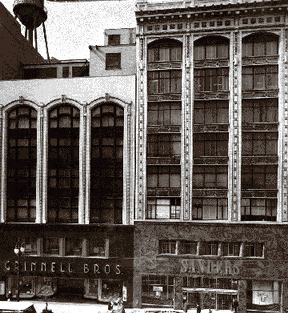
Sander’s Building beside Grinnell Brothers |
Another staple of Fran’s children’s lives in Detroit was Sanders, an ice cream shop that opened in 1875. Among its other successes, Sanders invented the ice cream soda. My mother Diane has very fond memories of riding the street car with her grandmother Lucy to Sanders for sundaes and fudge cream puffs. See the attachment at the end of this chapter for the authentic bumpy cake recipe.
Detroit Today
One family member, Carol De Puys, remained in Detroit until her husband was robbed at gunpoint at the corner of their street. They left in 1985; however much she loved the city it was just too dangerous to stay. She had very much wanted her daughter Krista to go the prestigious Cass Technical High School, which Carol’s father Alanson had attended. Krista finished only the 7th grade before the family moved to Saint Clair Shores.
Detroit has seriously deteriorated over the years, from the glory days of the 20s, 30s, 40s and 50s, to the White Flight period of the 50s and 60s. Detroit succumbed to the national racial tensions in the 60s and 70s, and the death knell was the decline of the automobile industry in the 70s and 80s. The 80s saw wide-spread drug addiction, particularly in the form of crack cocaine, spawning violence as addicts committed crimes to obtain money for the drug. There have been sporadically successful efforts at urban renewal. As of 2010, the educational system of Detroit remains one of the worst in the state. Unemployment runs a staggering 44%. Burned out ruins of the 1967 riots still stand, however precariously. Political scandal plagues the city. Plans to radically alter the landscape of the city by centralizing citizens to concentrate resources in a more limited space are being considered.
Hillsdale
In 1954, the family moved from Detroit to the small community of Hillsdale, Michigan. Fran had been working as a master tool and die maker at Richard Brothers in Detroit. During WWII, the shop was converted to an airplane manufacturing plant. He was considered essential personnel and for that reason was not drafted. After the war, he was wooed to serve as a superintendent at Allied #4, a tool and die shop, in Hillsdale. Fran was very successful professionally.
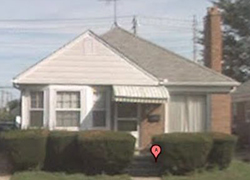
After moving to Hillsdale, the couple built their dream home at 146 Hillcrest Drive with a mortgage of less than five years. They furnished it with the beautiful pieces they purchased as a young married couple as well as new pieces. It was the showplace of the neighborhood and the couple allowed tours when it was finished. The kitchen was the height of 1950s fanciness and included a dishwasher, a very new appliance at the time. Arlene Taylor and her husband, neighbors, toured the house and he later reported it was the most expensive tour he ever took: Arlene demanded a new kitchen.
Education was important to Fran and Elaine, both took college preparatory classes in high school, although neither went on full-time to college. Fran, a math wizard like his sister Audrey, would bring math problems home and pose them to the kids at the dinner table.
All of their children and grandchildren have college degrees. Norm has two Masters and a Ph.D. in mathematics; Tom has actuarial credentials similar to a law degree. Diane has a Bachelors in English. As of this writing, two of the grandchildren have gone as far as to earn a Master’s degree, Mike and myself. Elaine threw a huge family party at her nursing home to celebrate the family graduations of 1996: Wayne State Library Science school (a Masters) for me, a Bachelors in Communications from Ohio State University for Marne, and Alicia’s graduation from high school, after which she went on to Davenport University.
The First Presbyterian Church of Hillsdale, Michigan
Fran and Elaine tithed to, and were deacons at, the First Presbyterian Church of Hillsdale, Michigan. Elaine also taught Sunday school there. The minister at that time, Gardner Winn, played a role in the family’s life. He was present at crucial moments and officiated at significant events.
Both Fran and Elaine were buried out of this church. Two of their children, Diane and Tom, married out of this church. Elaine’s second marriage, to Jack Hess, was also in this church.
When my mother and I went to Hillsdale to make funeral arrangements for grandma, the current church secretary let us know that Elaine and Jack had been on their prayer list for several months. She was easily able to pull the records of Elaine and Fran’s work at the church from the late 1950s.
Elaine and Fran were part of a national religious tide. By 1960, church attendance in the United States was at an all-time high: 69% of the country reported church membership. “The new Revised Standard Version (RSV) of the bible spent an unprecedented three years on the best-sellers lists. In 1954, the words “under God” were added to the Pledge of Allegiance, and “In God We Trust became a part of the country’s coinage the following year” (Young and Young p. 8).
Father’s Day, 1961
I grew up hearing tales of Fran and asking questions about him. How he took three sandwiches to work with him every day and yet remained rail thin. The yearly fishing trips to Lake Kindiogami in Canada with his brother Howard. About how they were buried just a few feet from one another, buying plots at the same time as young men.
And about the night that he died. The events leading to his death began 3 June, 1961, Diane’s birthday, when he experienced a cerebral aneurism. Elaine went to bring in a neighbor who was a doctor.
Fran died on Father’s Day, 1961, at Henry Ford hospital in Detroit. As the final aneurism ruptured and it took its toll, Fran fought. Abruptly, however, he calmed down, focused his gaze on something at a corner of the ceiling and told Elaine, “Oh, how ridiculous I’ve been, he’s here waiting for me,” and died peacefully.
Elaine was at the hospital along with the family minister, Gardner Winn, and Audrey. Diane was home in Hillsdale playing Canasta with Elaine’s mother Lucy. Gardner Winn came home with the news. “Well, how is Fran?” Lucy asked. He responded, “Not so well, he died about three hours ago.” And that was the start of my mother’s atheism.
Tom was leaning toward atheism at the age of 10 or 11 and the matter was settled for him when his father died. He remembers that the morning after his father died his mother was a wreck but he had a paper route that he was determined to deliver.
Norm had just left for a summer job at Interlochen before college at the University of Michigan. Fran and Elaine had spoken about Norm after Fran’s first aneurism. Fran told Elaine not to let Norm come home to live again if he died; he wanted Norm to have a life of his own and to attend the University of Michigan. Fran’s boss, Mr. Esdale, traveled to Interlochen the next day to bring him home for the funeral. Norm returned to his summer job shortly after the burial.
Fran’s viewing was at Van Horn-Eagle Funeral Home in Hillsdale and he is buried at Cadillac Memorial Gardens in Clinton Township.
Diane and Tom continued to live at home, they were 15 and 12. Also in the house was a German exchange student named Norbert. When Diane and Tom went back to school at the end of the summer, Elaine got a job at Harris, Reams, and Ambrose, working as a secretary. The men at the CPA firm were very kind to her and did things like help her dig her driveway out of the snow during Michigan’s harsh winters.
But her mourning was long. She cried every day for two years after Fran’s death.
The couple had arranged their finances carefully. She went to an accountant who looked over her situation: a house that was paid for, a car that was paid for, no debt, and a small life insurance policy. He told her that if she could live on her wages she would be able to keep the house. She did just that. He was so impressed he didn’t charge her for his services. He said he’d never had a client follow his advice so carefully.
When I chose to change my name after conflict with my own father, I wanted to get closer to my mother’s family. Fran played a part in my embracing the name Schryer and my interest in the Schryer family history. Fran’s family. My family.
I grew up hearing many wonderful stories about Fran, as well as painful stories of the chasm his death left in the family, and listening at our regular family gatherings to my mother’s brothers tell stories about their childhoods, the rhythms of the family’s life in Hillsdale in the 50s and 60s, the days surrounding Fran’s aneurisms, and finally his death.
In 2009, Ann Lawson of Ontario found me while conducting her own genealogical research. “Are you Francis Schryer’s granddaughter?” she asked. Despite his shadow over me, she was the first person to ever ask me that question.
I am unquestionably, determinedly and joyfully my grandmother’s granddaughter, but only a phantom relation of his. Yes, I could finally tell someone. Yes, I am Francis Schryer’s granddaughter.
But where do loyalties lie? How can I reconcile a living man, Grandpa Jack, however good to me, with a dead one who feels nearly legendary? Behind the title of “Grandpa” has always been the man Grandma is buried next to: Francis William Schryer.
After Tom left the house for college at Michigan State University, Elaine sought a second husband. See the section on Grandma’s second family for the history of her life with Jack, and the two step-sons she raised with him: my uncles Steve and Greg.
 Plum Librarian LLC