When I began my adventure in the stateside portion of my independent study on Katherine Philips, I started out in the special collections room of my own university, Michigan State University. It had an original printing of Philips’s work from 1710. I spent hours copying out her poems in pencil, one by one. Learning her style, learning her. It was also the only way I could study her work outside of the library. However, by the time the semester was part-way through, an edition of her poetry was re-printed for the first time in nearly 350 years.
Philips was coming back around again, and I was there for the start of it.
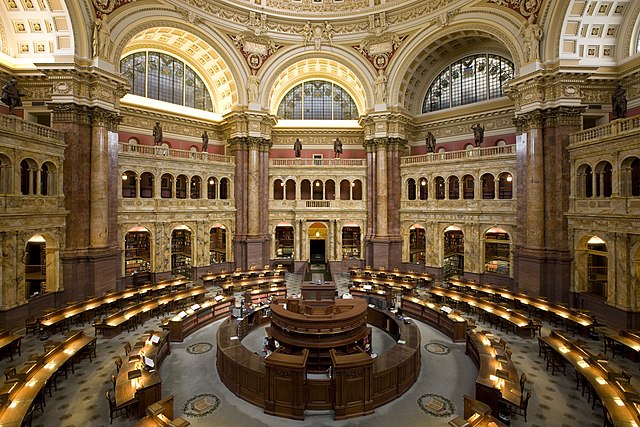
During that first semester, I traveled to the Library of Congress (still have my LC library card, too) to research their rare materials on Philips. The building was magnificent.
I sat at a desk and asked the librarians to bring me books because the stacks were closed – no one but librarians could actually go get a book from the shelves. That was my first experience with this phenomenon, but not my last. I went through half a dozen texts that I could not access from Michigan – could not access from anywhere but there. My mother warned me that I might have to wear white gloves to touch the books. I was kind of looking forward to that level of formality but alas, I was denied the white glove treatment.
The librarians expressed some interest in my interest in Philips. I expressed that they worked in a very, very nice building. They concurred.
As I began to dig into the Library of Congress’s rare materials, I felt a growing responsibility to Katherine Philips, and to women writers in general. Too often forgotten. Seldom published or taken seriously in their own time. The fragments of criticism that I was finding were sometimes patronizing, sometimes dismissive. It made me angry.
Katherine Philips’s genre is defined as romantic female friendship poetry. She writes mainly of her fiery, intensely emotional relationships with women. During her lifetime, she fostered the intimacy she craved in a closed, members-only circle of her creation and then memorialized them in print. Some of those drawn in by her might be tempted to add “minor-league cult leader” to her epitaph.
I was absolutely fascinated.
Women’s emotional experiences of friendship were shrouded by time and more often revealed in unpublished letters than collections of poetry or novels. Male friendship was its own literary genre. It was respected. But relationships among women were not taken seriously among early scholars of English literature.
My professor was already encouraging me to publish, but that felt too “big.” I was an undergrad and I still felt small. It did not deter my private obsession to come to an understanding of Katherine Philips.
And what was I supposed to do with her romantic allusions? My limited life experience hindered my imagination on the kaleidoscope of relationship possibilities among and between women.
One day at lunch, I took my tuna fish sandwich and my backpack and left the Library of Congress to eat and stretch my legs. I had traveled from Michigan to DC and packed my own food for the trip. I was working three jobs to help keep myself in school and there were no extra pennies. I headed over to the House of Representatives across the street and found a nice, big window seat to repose on in a dirty hallway full of broken furniture and littered with paper. It was between congressional sessions and it looked JUST LIKE a college dormitory the day after the students leave – trashed. You could smell both old sweat and the paint fumes coming from far off down the hall where they were starting to touch up the walls. I watched the city and ate my lunch (pre-911, you could go pretty much anywhere in DC). I still remember that moment. I felt so free, and so thrilled to be chasing a woman nearly forgotten by history.
I also traveled to the University of Chicago that first semester to review an important dissertation unavailable to anyone not sitting in their library (trust me, I tried hard before I actually went there. No, it’s not available through UMI.).
At the end of the semester, my professor said that if I wanted to go deeper, I would need to go to London, and to Wales. To the British Library, and the National Library of Wales. I was excited. I felt like what I was doing was important. It was a grand adventure – researching a woman who had potentially hidden a lifetime of Lesbian expression behind the socially acceptable relationship form of friendship.
I was dating a German exchange student named Greta during my Junior year. We each had rooms in the same co-op house in East Lansing. She was doing research in the engineering department and her time in the States was ending. Now she could show me her home and introduce me to her family.
Michelle was another exchange student, French, whom my family had hosted for a summer while I was in high school. She spoke five languages and had repeatedly invited us to visit her. Now, I was going to.
 Plum Librarian LLC